Why Croydon Drains Block — and Why Stormwater Is the Bigger Story Here
Plenty of suburbs have a reputation for drainage trouble. Croydon has a written record of it, which is rarer, and it is the reason we treat stormwater as the headline issue in this postcode rather than an afterthought.
One Drain Blocked, or Every Drain?
Before you call anyone, count the fixtures involved. It takes about half a minute, it costs nothing, and it changes what needs to happen next more than any other piece of information you can give a plumber over the phone.
What to Do Right Now
These five steps keep a Croydon blockage from turning into a clean-up while you wait for us. They are listed in the order that matters.
- Turn the taps off and leave them off. Every litre you send down a blocked line has to go somewhere, and the lowest opening in the house is usually a shower base or a floor waste.
- Do not run the washing machine or dishwasher. Both dump a large volume in one hit, which is exactly what turns a slow drain into an overflow.
- Walk outside and find the grated drain closest to the house. That fitting is the overflow relief gully, and it is built to be the lowest opening on the whole property, so anything backing up is pushed out at ground level rather than through a bathroom. Bubbling means it is doing exactly what it was installed to do. Never pave it over, plant it out or stand anything on top of it.
- If it is a storm, check the downpipes and the surface pits. A leaf mat sitting on a grate is a two-minute fix that can stop water backing up against the wall while you wait.
- Leave the drain chemicals in the cupboard. They will not shift roots or set grease, and what they do achieve is leaving a line full of caustic liquid for whoever opens it next.
Wastewater rising indoors counts as an emergency at three in the morning just as much as at midday — ring 0425 226 636.
When Croydon Drains Block — The Seasonal Pattern
The calls arrive in a fairly predictable rhythm through the year, and knowing it lets you get in front of the problem instead of reacting to it.
🍂 Autumn
Leaf drop overwhelms gutters, downpipes and yard grates alike. An afternoon spent emptying them in March or April is the cheapest insurance a Croydon house buys all year against a wet June.
🌧️ Winter
Sustained rain finds every stormwater line that is not running at full bore. This is peak season for blocked storm water calls in Croydon, especially on lower blocks near the creek corridors.
🌱 Spring
Root activity picks up sharply. A sewer line that was cleared over winter commonly closes over again now if the defect that let the roots in was never sealed.
☀️ Summer
Dry ground drives roots down toward whatever is still damp, which is often a leaking joint. Kitchen waste lines also fur up faster with fat during long dry spells.
Who Is Responsible for a Blocked Drain in Croydon — You, the Council, or Yarra Valley Water?
Croydon sits in the City of Maroondah, and the council's rules on this are clearer than most people expect. The phrase that decides it is point of discharge, also written as the Legal Point of Discharge. Maroondah's wording is that property owners are responsible "for the maintenance and repair of drainage up to and including the point of discharge" into Council's stormwater system. Everything on your side of that point is yours.
🌧️ Council drain, or private drain?
This is the split that matters. A blocked or broken Council drain gets reported to Maroondah on 1300 88 22 33, staffed 24 hours. A blocked or leaking private drain, in the council's own phrasing, means "Contact a plumber".
⚖️ Water coming from next door
Maroondah says it is not designated under the Water Act 1989 to enforce nuisance flooding between two private properties, and it does not mediate. It points people to the Dispute Settlement Centre of Victoria on 1300 372 888.
💧 Groundwater and seepage
Council also states it is not responsible for groundwater or sub-surface seepage — that sits with the property owner. Ground that never dries is a different problem from a blocked pipe, and it wants a different solution.
Sewer is a fourth party again. Blocked sewers in Croydon fall under Yarra Valley Water, contactable on 132 762, and their network is entirely separate from the council's stormwater system. Rainwater and wastewater are not supposed to meet, and one of the more common faults we find in older Croydon properties is exactly that: a downpipe or surface drain plumbed into the sewer, or a sewer defect letting stormwater in. Both show up immediately on camera.
Renting in Croydon? Pipework is part of the building, so repair costs generally fall to whoever owns it — with the caveat that a renter can end up wearing the bill when the blockage was plainly created by something that had no business going down there. Tenants: raise it by email so the request carries a date, photograph what you can see, and let the agent be the one who books a trade. Owners and property managers: ask for the recording, because footage is the only thing that reliably separates a pipe that has failed from a pipe that has been misused. Our guide to who is responsible for a blocked drain sets it out at length.
Signs Your Croydon Drain Is Blocked
Some of these send people straight to the phone. Others get tolerated for a year before anyone links them to drainage.
- Noises moving between fixtures — flush the toilet and the basin burps, or run the bath and the shower gurgles. Our guide on gurgling drains explains why that happens.
- Water in the yard that arrives with rain and stays — the classic Croydon stormwater symptom, usually silt or roots in a pit or the outlet line.
- The outside grate spilling — your overflow relief gully is releasing a surcharge outside rather than into the house. Treat it as urgent.
- A smell that comes and goes with the weather — see why drains smell.
- The same fixture blocking on a cycle — every spring, or every time it rains hard. That is a defect, not bad luck.
- Green stripes or a sunken line across the lawn — often traces the path of a leaking pipe underneath.
- The kitchen sink taking longer each month — cooled fat closing the pipe down from the wall inwards. See kitchen sink draining slowly.
How We Clear a Blocked Drain in Croydon
1️⃣ Name the system before touching it
Rainwater or wastewater? A single branch or the pipe everything shares? And where does it open up for access? On anything shared, the CCTV camera goes down ahead of any machine.
2️⃣ Match the machine to the material
Soft, local obstructions come out on a drain machine. Roots, hardened fat, silt and scale get 5000 PSI water jetting, which scours the wall rather than simply punching a hole through the middle.
3️⃣ Film it afterwards
Once water is moving again the camera goes back down, and what it records is the finished bore plus whatever condition the barrel is in upstream and downstream of the trouble. That recording belongs to you.
4️⃣ Tell you what caused it
A fracture, a dropped joint, a badly made connection — whatever the camera found gets described to you straight, including the cases where leaving it be for now is the honest advice. Relining is the permanent answer when it is not.
Watch a Real Croydon Drain Job
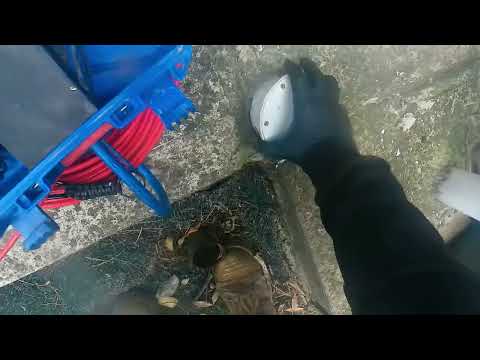
This is a Croydon job where the camera earned its place in the van. The blockage was being caused by badly made pipe connections underground, which is something no amount of poking from the surface would have identified — you can clear it, but until you have seen it you have no idea why it happened or when it will happen again.
Repeat Blockages: When Croydon Pipes Need Relining, Not Clearing
There is a point at which clearing the same line again stops being maintenance and starts being a subscription. If a Croydon drain has closed over twice in the same place, the pipe itself is the problem.
The repair happens from inside the pipe, and nothing above ground has to be opened up to do it. A felt sleeve soaked in resin is winched along the failed run, pressed out tight against the host pipe and left to harden, so a split barrel and gaping joints all finish up behind one seamless new wall. Driveways, crossovers and established gardens are left exactly as they were. It also treats the actual failure instead of the symptom: clearing takes out what grew inside the pipe, whereas a liner shuts the doorway it grew through — and that doorway is the only thing deciding whether we are back next spring.
With so much earthenware still carrying wastewater beneath Croydon's older streets, this is a suburb where relining tends to be the sensible call rather than an over-reaction. More detail on pipe relining, and a side-by-side look at relining versus replacement.
What We Unblock in Croydon
We are in this postcode most weeks, and the same handful of jobs come round again and again.
🌧️ Blocked stormwater, Croydon
The big one here. Silt and leaf litter in pits, choked downpipe lines, and outlets that have partly collapsed. It shows up outdoors, not indoors — water against the house, or a lawn that will not drain. See stormwater drains.
🚽 Blocked toilet, Croydon
Wipes and paper mostly, or something further down the line that the toilet is simply the first fixture to notice. If it rises when the shower runs, the fault is not in the toilet at all. See blocked toilets.
🪣 Blocked sink, Croydon
Fat cools along the kitchen branch and lines it a fraction thicker each year, until one rinsed roasting tray tips the balance. Basins are the same story told with hair and shampoo scum. Neither takes long once the cause is taken out rather than poked through. See blocked sinks and blocked basins.
🌳 Blocked sewer, Croydon
The whole-of-house version. Roots through an earthenware joint, and every fixture stops because they all discharge into the one pipe. Needs jetting and a camera. See blocked sewers.
🚿 Slow shower or floor waste
Nearly always hair and soap within the first metre, unless the rest of the house is misbehaving too. Worth clearing properly rather than repeatedly. See blocked showers.
🚨 Emergency plumber, Croydon
Sewage indoors, or a storm that has put water where it should not be. We cover Croydon around the clock for genuine emergencies and you speak to Jack directly. See emergency blocked drains.
Drain Services We Provide in Croydon
- Blocked drains — same-day clearing across 3136
- Stormwater drains — silted pits and choked outlets on the Civic flat
- Stormwater health check — before the winter rain, not after
- Blocked sewers — earthenware mains under the older Croydon streets
- CCTV drain inspection — see the cause on screen
- Hydro jet drain cleaning — 5000 PSI on roots, storm silt and set fat
- Blocked toilets and blocked sinks
- Blocked showers and blocked basins
- Pipe relining — no-dig repair for failed earthenware
- Pipe locating — find the line before you dig
- Pre-purchase drain testing — check the drains before settlement
- 24/7 emergency blocked drains — any hour, any day
- Commercial drains — shops and cafés around Main Street, Croydon Central and the Arndale strip
The Croydon Civic Catchment — Three Floods in Thirteen Months
The Maroondah Flood Management Plan, prepared with Melbourne Water and dated May 2016, records that inside a span of thirteen months the suburb copped three separate hits: 1 December 2010, 4 February 2011 and 9 November 2011. All three brought significant flash flooding to the Croydon Civic drainage catchment, and the plan notes "many residential properties impacted above floor level". As at that plan, mitigation works around Civic Square and Lusher Road had commenced.
Melbourne Water's own description of the November 2011 storm is worth reading in full: "Croydon bore the brunt of the storm – in particular the area around the Croydon Civic Square and Lusher Road. Drivers found themselves trapped in flash flooding… Within hours, emergency services were overwhelmed, answering hundreds of calls for help."
The plan also puts modelled severity against named streets. Lacey Street, Croydon flooded in the December 2010 storm, assessed as roughly a 60-year ARI event. Kauri Court and Parrs Road, Croydon went under in the February 2011 storm, roughly an 80-year ARI event. Council commissioned two separate studies off the back of it, a Civic Square Flood Modelling and Mitigation Assessment and a Kauri Court Flood Modelling and Mitigation Assessment, both in 2011.
None of that means your own drain is doomed. What it means is that the public system in this part of Maroondah has spent decades working close to its ceiling during big storms. A private stormwater line half full of silt and leaf litter has nowhere to push its water when the receiving system is already loaded, and that is the moment a slow drain turns into water in the house.
Two Creeks — Tarralla Daylighted, Brushy Creek Remembered
Croydon sits between two waterways: Brushy Creek to the north and Tarralla Creek to the south. Tarralla has been the subject of one of the more interesting drainage projects in Melbourne's east. Melbourne Water describes the first stage this way: "Completed in 2022, Stage 1 saw 500m of concrete pipes converted into a natural waterway, and upgrade to the Croydon Drain Wetland between Vinter Avenue and Norton Road."
More than 80,000 new plants went in, and the work has since collected both national and international awards. The full project stretches almost two kilometres, from Dorset Road through to Eastfield Road, and Stage 2 will daylight a further 886 metres between Vinter Avenue and Eastfield Road, with construction starting early 2027. Retarding basins sit along Tarralla Creek inside Dorset Recreation Reserve and Town Park.
Brushy Creek, by contrast, is remembered for what it did rather than for how it has been rebuilt. It put North Croydon under water in 1972, reportedly close to two feet deep, then repeated the performance in 1975. What followed was a flood mitigation scheme built around a nine-foot barrel culvert driven under Maroondah Highway, together with a retarding basin sitting upstream of the highway.
For a homeowner the useful takeaway is simple. A great deal of water moves through this suburb, and the public half of the network carrying it is being actively rebuilt and improved. The connection between your roof and that network is the half nobody is upgrading on your behalf.
How Croydon Grew, and What It Left Underground
The name has been in use since the 1880s, the railway station opened in 1882 and the primary school in 1888. Between the wars the population tripled to roughly two thousand. Then the pace changed. Victorian Places, the local history project run by Monash University and the University of Queensland, records that Croydon "became part of the post-war growth of metropolitan Melbourne" with "more than a fourfold population increase between 1947 and 1961". The census figures track it plainly: 644 people in 1911, 3,385 in 1947, and 20,780 by 2001. In 1964 the Arndale centre opened here, the first fully air-conditioned shopping centre in Victoria. Croydon governed itself as a Shire from 1961 and a City from 1971, until it merged into the City of Maroondah in December 1994.
Drainage follows housing, and housing that went in across the middle decades of last century left a lot of earthenware in the ground. Earthenware is jointed at short intervals rather than run continuously, and every one of those joints is a weak point that roots can find once the pipe has shifted or cracked. That is why a Croydon drain that has blocked once so often blocks again in the same spot — the roots were removed, but the opening they came through was not.
Frequently Asked Questions — Croydon
Blocked Drains in Suburbs Near Croydon
Croydon North and Croydon Hills occupy the higher ground north of Maroondah Highway toward Brushy Creek, and the drainage questions there tend to be about fall and surface run-off rather than standing water. Croydon South runs the other way, down past Eastfield Road onto flatter country, where lines discharge more slowly and stay dirtier for longer. All three share postcode 3136 with Croydon proper, and all three are on the same run for us — a job in Croydon Hills or Croydon North is no different for us to attend than one on Main Street.
Beyond the postcode, Kilsyth and Mooroolbark sit immediately north and east, Ringwood is the next town centre west along the Lilydale line, and Montrose and Mount Evelyn begin the climb into the ranges. We work across all of them with the same jetter and the same camera.
Blocked drain in Croydon sorted today
Free over-the-phone diagnosis, and Jack attends the job himself. Same-day drain cleaning across Croydon 3136 in most cases.
📞 Call Jack — 0425 226 636Sources for the local information on this page: City of Maroondah and Melbourne Water Flood Management Plan (May 2016), including the Croydon Civic catchment events and the Lacey Street, Kauri Court and Parrs Road modelling; Melbourne Water on the 9 November 2011 storm and on the Tarralla Creek daylighting project; City of Maroondah drainage, point of discharge, nuisance flooding and groundwater guidance; Yarra Valley Water as sewerage authority; Victorian Places (Monash University / University of Queensland) for Croydon's settlement and population history, including the Arndale centre and the shire and city dates.