Donvale Is Two Suburbs Wearing One Name
Most suburbs have one drainage story. Donvale has two, and they are separated by a single road.
The suburb took its own identity from about 1929, when the Donvale post office opened on 16 September that year, closing again in 1972. The name is a straight assembly of the two roads that define it, Doncaster Road and Springvale Road. Before any of that it was high, quiet ground: a tuberculosis sanatorium opened here in 1910 on the elevated country, the site later became a Whitefriars monastery around 1940, and Whitefriars College followed in 1961. Victorian Places captures the moment neatly: "In 1961 Whitefriars Catholic boys' college opened, still in a rural setting, but new houses were well to the fore later in the decade."
Then the schools arrived in a rush, which is always the surest sign of a suburb filling: state high and primary schools in 1967 and 1968, Donvale Christian College in 1975 and a Catholic primary school in 1978. The population settled rather than surged after that, moving from 10,973 in 2001 to 11,795 in 2011. And the eastern half never really converted. As Victorian Places puts it, "Donvale's wide open eastern spaces continue to prevail."
That last sentence is the whole page in miniature. A suburb that urbanised on one side and stayed on large land on the other ends up with two different kinds of private drainage, two different relationships with the public system, and two different sets of things that go wrong.
The Manningham Rulebook: Nominated Point of Drainage Discharge
Manningham's everyday term is the legal point of discharge, shortened to POD, while the written policy calls it the Nominated Point of Drainage Discharge. Council explains the concept in one sentence: "Stormwater that falls on a property is collected and drained to what is usually the lowest point on the property, which is known as the 'legal point of discharge'." The point itself is defined as "the nearest pit or drain of adequate depth and capacity", or where that is not obvious, "a point specified by a council officer."
Council's long-standing drainage policy, marked as under review, recognises four things that can serve as that point. A pit or drain belonging to Council and sitting in an easement or road reserve. A swale drain in a road reserve. A drain belonging to Melbourne Water. Or a natural watercourse. In a suburb with wide verges and open channels running along the eastern streets, the swale option comes up far more here than it would in a fully kerbed suburb, and a swale that has been filled, landscaped or driven over quietly stops working as a discharge point without anybody deciding that it should.
📏 AEP, not ARI
Council designs its underground network to a 20% AEP storm, meaning one with a one in five likelihood in any given year, and applies 20% AEP to on-site detention discharge with 10% AEP to storage. Beyond those thresholds, water is expected to move across the surface.
🌊 The 60 hectare line
Catchments greater than 60 hectares are Melbourne Water's responsibility rather than Council's. Worth knowing before you spend a week chasing the wrong authority about a channel.
🏛️ Who to ask
The Civic Centre is at 699 Doncaster Road, Doncaster, and the number is (03) 9840 9333. POD enquiries, council drain reports and drainage plan requests all start there.
Council is also refreshingly frank about why older parts of the municipality behave the way they do: "Most flooding problems occur because older suburbs (like those in Manningham) were built using different design standards to those that apply today. Suburbs developed before the mid to late 1970s did not need to plan for how water would flow over land when the drainage system was full." Donvale's schools opened in 1967, 1968, 1975 and 1978, which places a good deal of its residential development squarely inside the period Council is describing. Overland flow was not part of the brief. It happens anyway, and on a large block it happens somewhere you may not be watching.
Watch a Real Donvale Drain Job
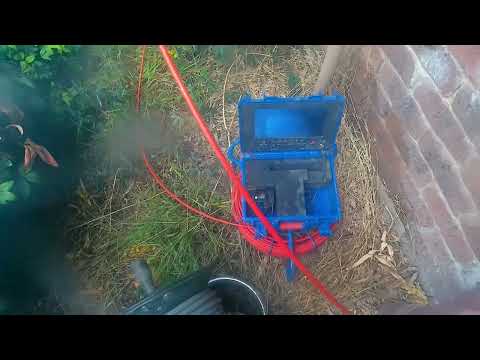
A short clip that makes the point better than a paragraph can. What looked like an ordinary blockage turned out to be a poorly made toilet connection somebody had left behind, and it would have kept blocking indefinitely. The camera showed it, and it was corrected properly rather than cleared and forgotten.
Is It One Fixture, or All of Them?
Work this out before you call. It is thirty seconds of checking and it changes the diagnosis completely.
Useful Things to Do Before We Get There
- Turn the water off at the fixtures. Anything that goes in has to reappear at the lowest opening in the system, which indoors is usually a shower base or a floor waste rather than the drain you first noticed.
- Do not run an appliance. A washing machine tips its whole load into the line at once, and on a partly closed run that is the moment it comes back at you.
- If you are on septic, do not add to the tank. No laundry, no long showers. Where waste is being held rather than dispersed, every litre reduces the margin you have left.
- Clear the top of the outside grate. That grated fitting is the overflow relief gully, set deliberately below every fixture indoors so a surcharge lifts out into the garden. On a big block it is easy to lose under planting and easy to stack things on.
- Leave the supermarket drain products alone. They do nothing to roots or hardened grease, and they leave a pipe full of caustic liquid that has to be made safe before any work can start.
Wastewater appearing inside the building is urgent regardless of the time. Ring 0425 226 636.
Donvale Through the Year
🍂 Autumn
Canopy cover here is heavy and the pits are far apart. Gutters, downpipe lines and grates all fill quietly, and on a long run the material does not stop at the first obstruction, it travels and settles further along.
🌧️ Winter
Saturated ground stops absorbing, and any soakage or trench arrangement on a large block reaches its limit. This is when a septic system that has been coping quietly for years stops coping.
🌱 Spring
Underground growth accelerates and heads for whatever is leaking. A run cleared in winter closes over again now if the entry point itself was never repaired.
☀️ Summer
The best window for planned work on an acre block: locating pits and access points while the ground is dry, relining a failing length, and getting the stormwater checked before autumn drops on it.
Who Is Responsible for a Blocked Drain in Donvale?
Three owners, and on the acreage side the split is wider than most people expect.
🚽 Sewer — Yarra Valley Water
The wastewater network here belongs to Yarra Valley Water on 13 27 62, which ran the reticulation through the suburb. If the fault is in the public sewer rather than your line, that is the call. See blocked sewers.
🌧️ Stormwater — City of Manningham
Council owns the public drainage beyond your point of discharge, and reports go to (03) 9840 9333. There is no published clearing time for a blocked street drain, so record the date you called.
🏠 Everything before that — you
Council's wording is unusually wide. Ownership of construction and maintenance runs across every drain, expressly "including drains outside of the property boundary", and continues until Council's own stormwater system is reached. On an acre block that is a lot of pipe.
The recurring difficulty in Donvale is simply finding the boundary. On a large, established, well-planted block the point of discharge is often invisible, and on properties that came off septic in 2019 the drainage was frequently rearranged at connection time without anything being recorded. Responsibility cannot honestly be assigned to anybody while that point remains unfound. Once it is located and filmed, the ownership argument stops being an argument.
Renting in Donvale? Repairs to drainage normally fall to the owner, since the pipework forms part of the building, though a blockage obviously caused by misuse is handled differently. Tenants: write the request down so there is a date attached to it, and photograph what you can see, including any wet ground out in the yard. Owners and managers: view the camera file before you sign anything off, because on a property with septic history the footage regularly shows something quite different from what everyone assumed. Our guide on who is responsible for a blocked drain goes into it further.
Warning Signs on a Donvale Block
- Noise passing between fixtures when only one is in use — a shared line telling you it is restricted. See why drains gurgle.
- A patch of lawn that stays wet through a dry fortnight — on a property with septic history this deserves attention quickly rather than eventually.
- Water pushing up out of the outside grate mid-storm — that is the overflow relief gully protecting the house. Deal with it straight away.
- Water ponding well away from the house — usually a buried pit or a silted outlet somewhere along a long run, not a problem at the building.
- The same length of drain failing more than once — that is a defect with an entry point, and clearing it again just resets the clock.
- A smell outdoors that shifts with the weather — the explanation is in why drains smell. For the kitchen on its own, read kitchen sink draining slowly.
- A downpipe or laundry line you cannot account for — worth resolving properly in this suburb, given where the stormwater ends up.
How We Clear a Blocked Drain in Donvale
1️⃣ Find the system before touching it
Storm or waste, sewered or septic, one branch or the whole house. On the eastern blocks that starts with locating the access points, because on a lot of properties nobody has seen them in decades.
2️⃣ Camera first on shared lines
On a run this long, the measured distance to the fault is what determines which access gets opened. Guessing on an acre block costs an hour that the camera saves in five minutes.
3️⃣ Clear with the right tool
Something soft and close to the fixture comes out on a drain machine. Roots, set grease and settled solids call for 5000 PSI jetting, which strips the deposit off the wall and carries it away rather than leaving a passage through the middle of it.
4️⃣ Film it again and say what it is
The camera goes back through and records the cleared bore and the pipe either side. You get told plainly whether it is sound, whether it wants repair, and you keep the recording.
Two Failures in the Same Length of Pipe Means the Pipe Is the Problem
A second blockage at the same point is a pattern rather than bad luck. Once that has happened, the defect is in the pipe itself, and another clear only resets the interval before the next one.
On a Donvale block the argument for relining is mostly about distance and disturbance. A private run that crosses a lawn, a gravel drive, an established garden and possibly the footprint of an old septic arrangement is an expensive thing to open up, and a trench across sloping acreage becomes a channel the first time it rains. Relining works inside the existing pipe: a resin-carrying liner is drawn into the failed length, pressed out firmly against the old wall and cured in place, leaving one continuous surface where the cracks and open collars were.
It is not universal. A length that has properly collapsed, or that has dropped so far out of grade that water sits in it, needs replacing rather than lining. The footage is what decides, and we will also tell you when a clear and a flush is genuinely all it needs. See pipe relining and the comparison of relining against replacement.
What We Unblock in Donvale
🚽 Blocked toilet, Donvale
Paper and wipes if the trouble stops at the pan. If other fixtures answer at the same moment, the fault is further out and the toilet is only the first to show it. See blocked toilets.
🪣 Blocked sink or basin
Fat that went down warm sets hard on the wall of the kitchen branch and narrows it without any warning at all. Basins bind with hair and soap. See blocked sinks and blocked basins.
🌳 Blocked house drain
Everything stopping together, because it all feeds one long run. On a Donvale acre block that run has more joints and more places to fail than most. See blocked sewers.
🛢️ Septic and containment systems
For the 383 properties not yet connected, the collection lines, access points and distribution runs all block like any other drain. We clear and camera them. See blocked septics.
🌧️ Stormwater on a large block
Pits that have silted up, outlets buried under later works, downpipe lines packed tight, and swales flattened by landscaping. It shows up as ponding a long way from the house rather than as a slow drain indoors. See stormwater drains.
🚨 Emergency plumber, Donvale
Waste indoors, everything stopped at once, or a gully overflowing after midnight. Donvale gets round-the-clock attendance and Jack answers the phone himself. See emergency blocked drains.
Drain Services We Provide in Donvale
- 24/7 emergency blocked drains — an emergency drain plumber for Donvale at any hour
- Blocked drains — same-day clearing across 3111
- Blocked sewers and house drains — including recently connected properties
- Blocked septics — for the hundreds of Donvale properties still on onsite systems
- Stormwater drainage — pits, downpipe lines, swale outlets and long yard runs
- Stormwater health check — sensible before autumn on an acre block
- CCTV drain inspection — recorded, explained, and the file is yours to keep
- Drain smoke testing — for finding cross-connections and unaccounted lines
- Hydro jet drain cleaning — 5000 PSI on roots, grease and settled solids
- Blocked toilets, sinks, showers and basins
- Pipe locating — the first job on most large Donvale properties
- Pipe relining — no-dig repair across long private runs
- Overflow relief gullies — the fitting that keeps a surcharge out of the house
- Pre-purchase drain testing — essential on a property with septic history
The Sewer Arrived Late — and 383 Donvale Properties Still Are Not On It
This is the fact that explains more about Donvale drainage than anything else, and it is documented in Council's own numbers rather than inferred.
Manningham's Onsite Wastewater Management Plan 2025 to 2030 is blunt about the history. It records that "areas such as Park Orchards and Donvale were by-passed" by the sewerage network, a situation that persisted until Council raised it in 2002, after which those areas were "identified as priority areas". Sewer then arrived in two very uneven waves.
Note the date carefully, because it is often reported wrong: the bulk of Donvale received sewer in 2019, not earlier. That is extraordinarily recent for a suburb this close to the city, and it means a great many Donvale properties have drainage that was designed, laid and extended over decades on the assumption that wastewater was going into a tank in the yard rather than into a main in the street.
Practically, that produces a specific set of jobs. House drains that were re-purposed at connection time and now run further than they were ever meant to. Old septic lines abandoned in place and occasionally still receiving something. Sullage runs that were never separated properly. And on the 383 unconnected properties, a complete private wastewater system that nobody but the owner is responsible for. All of it blocks, and almost none of it is on a plan.
Mullum Mullum Creek: Council Calls It One of the Most Polluted in the Catchment
Donvale's southern boundary is Mullum Mullum Creek, and Manningham does not soften what it thinks of its condition: "Mullum Mullum Creek is one of the most polluted streams in the Yarra River catchment according to Melbourne Water data and Council's water sampling results."
Put that sentence next to the number in the table above and the connection makes itself. 264 properties in this suburb are still putting raw sullage or treated effluent into the stormwater system, and the stormwater system in this part of Manningham drains toward that creek. We are not speculating about a cause; both halves are Council's own published material, and they sit in the same municipality's documents.
What that means on a job is straightforward and worth being honest about. In Donvale, a cross-connection between wastewater and stormwater is not a technicality that only matters on paper. A washing machine discharging into a stormwater pit, a sullage line teed into a downpipe run, or a failed septic overflow finding its way to a surface drain all end up in the same watercourse, with very little flow to dilute anything. It is one of the reasons we camera stormwater lines here more often than in most suburbs, and one of the reasons smoke testing earns its keep on older Donvale properties.
The creek is also the suburb's best asset. Mullum Mullum Creek Linear Park runs roughly nine kilometres along the western bank, between Heidelberg-Warrandyte Road and the EastLink Trail, and the Mullum Mullum Wetlands within it were brought back through regenerative planting during the 1990s. Currawong Bush Park, Mullum Mullum Reserve, Deep Creek Reserve and Buck Reserve adjoin it. That is a lot of protected ground for a suburb thirty minutes from town, and it is why what leaves a Donvale property matters more than the address suggests.
What the Sewer Trench Uncovered on the Creek Bank
The 2019 to 2020 sewerage excavation along the banks of Mullum Mullum Creek turned up something nobody had planned for. More than 2,700 Aboriginal stone artefacts were recovered, believed to be up to 4,000 years old, described by Yarra Valley Water as the largest undertaking of its kind in recent times on one of its projects. The Wurundjeri Woi-wurrung Cultural Heritage Aboriginal Corporation was engaged, and the artefacts were reburied following a smoking ceremony.
It is worth stating plainly on a page about drains: the ground beside this creek has been lived on and used for thousands of years, and the sewer project is a very recent chapter in that. Yarra Valley Water's stated reason for doing the work at all was ordinary enough by comparison, noting it would help prevent "soggy backyards and odours" for local residents.
One Road Splits Donvale's Drainage in Two
Here is the piece of local knowledge that changes how a job is approached before we even arrive.
Victorian Places records the division precisely: the part of Donvale west of Springvale Road, about one quarter of the suburb's area, has normal size house blocks, while the part to the east has blocks of about one acre. One road, two entirely different residential patterns.
That is not merely aesthetic, because Council's own drainage policy draws a line in almost the same place. The policy generally refuses soakage as a disposal method, stating that "The use of soakage or rubble pits as a point of discharge in urban areas, small allotments or steep terrain will not be permitted." But it carves out an exception for large land. On allotments over 1000 square metres, "including allotments located east of Mullum Mullum Creek", a soakage system may be acceptable where there is a satisfactory overflow, and the owner may be required to show that land is available for it in addition to any land needed to absorb effluent from a septic system.
Read that clause slowly. Council is contemplating a property large enough to need land for a soakage system and land for septic effluent, on the same block, at the same time. That is a description of eastern Donvale.
🏘️ West of Springvale Road
Conventional block sizes and conventional drainage geometry. Shorter runs to the street, discharge points that are usually where you would expect, and failures that behave like any established suburb: fat in the kitchen branch, roots at a joint, a silted pit.
🌳 East of Springvale Road
Acre blocks, long private runs with more joints and more bends, discharge points that can sit well away from the house, and a real chance of septic infrastructure still in the ground. Locating is frequently step one rather than an optional extra.
The practical consequence for an eastern Donvale owner is that distance is the enemy. A longer run collects more, drops more where the fall eases, and gives thirty or forty years of sheds, decks, driveways and garden works more opportunity to bury an access point. When someone tells us they have no idea where their drain goes, they are almost always calling from this side of the road, and they are not being careless. The information was rarely recorded in the first place.
Fifty-Three Metres Under Mullum Mullum Park
One more thing sits beneath this suburb that is worth knowing about. The Melba tunnel, citybound, and the Mullum Mullum tunnel, outbound, each run 1.6 kilometres and pass up to 53 metres below Mullum Mullum Park in Donvale. They were built so that traffic crosses the creek valley without the landscape above being disturbed.
It has no direct bearing on a household blockage, but it is a useful reminder of how much engineering exists under a suburb that presents as paddocks and bushland, and of why nobody should assume anything about what is underground here without looking first.
An Honest Word About Flooding in Donvale
It would be easy to dress this suburb up as a flood risk. The evidence does not support it, and we would rather say so.
Donvale is not on the VICSES list of Manningham suburbs most likely to be flood-impacted. It was not among the suburbs where homes were flash-flooded on 29 December 2016. Manningham lists no drainage capital works project for Donvale in the way it does for several neighbouring suburbs. On the public record, this is not a suburb the river or the storm network singles out.
There is also a gap on the other side of the ledger worth naming. Council does not publish any response time or service commitment for clearing a blocked street drain. We went looking and there is no stated window at all. So if you report a council pit on (03) 9840 9333, write down the date you did it, and in the meantime attend to the part of the system you actually control.
Donvale's genuine drainage issue is a different one, and it is better documented than a flood risk would be: a late-arriving sewer, hundreds of properties still not on it, 264 of them still discharging to stormwater, and long private lines on large blocks that nobody has ever mapped. That is the work here.
Frequently Asked Questions — Donvale
Blocked Drains in Suburbs Near Donvale
Manningham continues north and east, so Park Orchards and Warrandyte share the same council wording and, in Park Orchards' case, much the same sewerage history. Note that Park Orchards is postcode 3114 and split between Manningham and Maroondah, so it is not simply more of Donvale. West and south the councils change again: Mitcham, Nunawading, Blackburn, Forest Hill and Vermont sit under Whitehorse, Box Hill further along, and Ringwood and Ringwood North under Maroondah. One jetter, one camera, several rulebooks.
Need a blocked drain plumber in Donvale today?
Diagnosis over the phone costs nothing, most work is done on the day it is booked, and the number is answered after hours. Sewered or septic, big block or small.
📞 Call Jack — 0425 226 636Sources for the local information on this page: Manningham Onsite Wastewater Management Plan 2025 to 2030 for Donvale sewer provision dates, connection numbers, containment and stormwater discharge figures, and the statement about areas being by-passed and later identified as priority areas; City of Manningham material describing Mullum Mullum Creek as one of the most polluted streams in the Yarra River catchment; City of Manningham drainage guidance for the legal point of discharge definition, the Nominated Point of Drainage Discharge policy, permitted discharge locations including swale drains, the soakage pit restriction and the large allotment exception, AEP design standards, the Melbourne Water catchment threshold and the statement on older suburbs and overland flow; Yarra Valley Water material on the Mullum Mullum Creek sewerage works, the Aboriginal stone artefacts recovered and the involvement of the Wurundjeri Woi-wurrung Cultural Heritage Aboriginal Corporation; EastLink information on the Melba and Mullum Mullum tunnels and their depth below Mullum Mullum Park; VICSES Manningham Local Flood Guide for the list of suburbs most likely to be impacted; Victorian Places (Monash University / University of Queensland) for the Donvale post office, the naming, the sanatorium and college sites, school opening dates, the Springvale Road block size division and census populations; parks information for Mullum Mullum Creek Linear Park and the adjoining reserves.