The Township the Yarra Built
Yarra Street follows the river, and that is the shape of the place in one line. Warrandyte grew along the bank rather than out from a station, and almost everything about its water follows from that: land that falls hard toward the river, a main street sitting close to the flood plain, and reserves running along the water in both directions. Warrandyte State Park takes in an eight kilometre riverside reserve that reaches out to Wonga Park, along with Pound Bend and Whipstick Gully.
It is also where Victorian gold started. About two kilometres south of the township is Andersons Creek, described as "the site of the first gold discovery in Victoria in 1851, for which a government reward was paid", marked today by a cairn in Gold Memorial Road. Two decades later the miners went at the river itself: in the 1870s a tunnel was driven through rock at Pound Bend to divert the Yarra and expose the river bed for working. It is a useful reminder that people have been redirecting water through this valley for a very long time, and that the ground under a Warrandyte block has often been disturbed before.
The town's own record of high water goes back nearly as far. A bridge over the Yarra was washed away in a big flood in 1863 and took twelve years to replace. The township was flooded again in 1934. Fire has taken more, with 168 houses lost in the 1939 Black Friday bushfires and three houses destroyed in 2014. Between those events the suburb filled in steadily rather than suddenly, going from 1,085 residents in 1966 to 3,711 in 1976 and 5,520 by 2011.
For a plumber that history matters in a practical way. Warrandyte was not laid out in one decade to one standard. Drainage here has been added a property at a time over sixty years of building, on ground that ranges from river flat to genuinely steep, which is why we bring a camera rather than an assumption.
Manningham's Rules: Your Legal Point of Discharge
Manningham calls it the legal point of discharge, or POD, and in its written policy the Nominated Point of Drainage Discharge. The idea is simple enough: rainwater falling on your land is collected and taken to the lowest usable point, and that point is the handover. Council defines it as "the nearest pit or drain of adequate depth and capacity" or, where that is unclear, "a point specified by a council officer."
Then comes the sentence that matters most to a Warrandyte owner, and it is stronger than anything the surrounding councils publish: "The property owner is responsible for the construction and maintenance for all drains, including drains outside of the property boundary, up to the Council's stormwater system." Read that carefully. Not up to the fence. Not up to the kerb. Up to the council system, wherever that happens to be.
Council's long-standing drainage policy also fixes what a POD may consist of. Four options are recognised: a pit or drain owned by Council within an easement or road reserve, a swale drain sitting in a road reserve, a Melbourne Water drain, or a natural watercourse. Soakage and rubble pits are ruled out as a discharge point on urban land, small allotments and steep terrain, which removes a shortcut that gets suggested surprisingly often on sloping ground. Larger holdings are treated differently: above 1000 square metres, and expressly "including allotments located east of Mullum Mullum Creek", a soakage arrangement can be considered where the overflow is satisfactory, with the owner potentially having to show there is land for it on top of whatever a septic system already needs.
📏 The design storm
Manningham states its standards in AEP rather than ARI. The underground network is designed for storms with a 20 per cent chance of occurring in a year. On-site detention is designed on 20% AEP for discharge and 10% AEP for storage.
🌊 Where Melbourne Water takes over
Catchments greater than 60 hectares are Melbourne Water's rather than Council's. On a river-edge suburb that boundary comes up more than you would expect.
🏛️ Where to ask
Manningham Civic Centre, 699 Doncaster Road, Doncaster, on (03) 9840 9333. That is the number for a POD enquiry, a council drain report or a drainage plan request.
Council is also candid about why the older parts of the municipality behave the way they do. It attributes most flooding problems to older Manningham suburbs having been built to design standards that no longer apply, and points out that development from before the mid to late 1970s carried no obligation to work out where water would travel across the ground once the pipes were full. Overland flow was simply not part of the brief when much of Warrandyte was laid out. It happens regardless, and on this terrain it happens quickly and downhill.
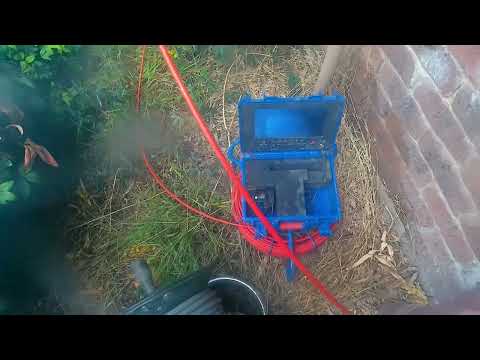
Watch a Real Warrandyte Drain Job
A good illustration of why the camera goes down before anything else. This blockage turned out to trace back to a badly made toilet connection left behind by an earlier plumber, so no amount of clearing was ever going to hold. Once it was on screen the fix was obvious, and it was fixed at the source rather than at the symptom.
One Fixture, or Everything at Once?
Sort this out before you pick up the phone. It takes under a minute and it changes what we load in the van.
What Helps Before We Arrive
- Stop putting water in. Every litre that goes down has to come out at the lowest opening available, and indoors that is usually a shower base or a floor waste rather than the fixture you noticed first.
- Do not start an appliance. A washing machine empties a large volume in one push, and on a restricted line that push is what takes it over the edge.
- Check the alarm panel if you are on the pressure system. Sounding points at Yarra Valley Water's equipment. Silent, with drains still misbehaving, points at your own pipework and at us.
- Find the grated fitting nearest the house and clear the top of it. That is the overflow relief gully, deliberately set lower than every fixture indoors so a surcharge lifts out there instead of in a hallway. Pot plants and mulch on top of it defeat the whole design.
- Skip the supermarket drain products. They will not move roots or set grease, and they leave a line full of caustic liquid that has to be dealt with before anyone can safely open it.
If wastewater is coming up inside the building, treat it as urgent whatever the hour and ring 0425 226 636.
Warrandyte Season by Season
🍂 Autumn
Leaf load on roofs and in pits, and on blocks that fall toward the river none of it stays put. The first proper downpour delivers a season's worth of litter into whichever pit is lowest.
🌧️ Winter
River levels rise and the ground stops accepting water. Outlets sitting low relative to the Yarra work hardest exactly when they are least able to, so this is when a marginal stormwater line finally announces itself.
🌱 Spring
Growth accelerates underground and heads for the moisture leaking out of a cracked joint. A line cleared in July closes over again now unless the opening itself was sealed.
☀️ Summer
The right window for planned work. Relining, locating buried pits and inspection openings, and a pre-winter stormwater check are all far easier in dry ground than in a storm at night.
Who Is Responsible for a Blocked Drain in Warrandyte?
Three owners, and Manningham has drawn the line between them more clearly than most.
🚽 Sewer — Yarra Valley Water
The wastewater network here belongs to Yarra Valley Water on 13 27 62, including the pressure sewer tank, pump, panel and boundary valve on connected Warrandyte properties. See blocked sewers.
🌧️ Stormwater — City of Manningham
Council runs the public drainage system from the legal point of discharge onward, and takes reports on (03) 9840 9333 at 699 Doncaster Road, Doncaster. No response time is published for a blocked street drain.
🏠 Everything before that — you
Council's wording covers all drains up to its system, "including drains outside of the property boundary". On a Warrandyte block that can mean a long private run you never realised you owned.
The practical difficulty is that on large, sloping, heavily planted blocks the point of discharge is frequently the thing nobody can find. It may sit well inside the boundary rather than at the kerb, and after decades of garden beds, retaining walls and driveway work it is often buried or surfaced over. Nobody can fairly allocate responsibility for a blockage while that point is still missing. We locate it, put the camera on it, and from there the ownership question answers itself.
Renting in Warrandyte? The pipework is part of the building, which normally puts the repair on the owner, though a blockage plainly caused by misuse is treated differently. Tenants, email the request so there is a dated record of it, and take photographs of whatever is visible. On a pressure sewer property, note whether the alarm was sounding, because that one detail often decides which organisation gets called. Owners and managers, get hold of the camera file before you approve anything. Our guide on who is responsible for a blocked drain covers the rest.
Warning Signs on a Warrandyte Property
- A basin that gurgles when the toilet is flushed — two fixtures sharing one restricted line. See why drains gurgle.
- The shower filling while the toilet is used — the shower is simply the lowest opening indoors reporting a shared-line fault.
- The outside grate lifting or spilling in a storm — the overflow relief gully doing its job. Treat it as urgent, especially on the lower streets.
- Run-off crossing the surface instead of entering a pit — usually a pit or outlet that has silted up, so the water simply goes around it and continues downhill.
- The same stretch of drain failing twice — a defect with an entry point, not bad luck.
- Ground that stays damp through a dry spell — often a leaking line feeding it, and on a septic property worth investigating quickly.
- Odour that turns up on some days and not others — our guide on why drains smell explains the mechanism, and kitchen sink draining slowly covers the kitchen version of it.
How We Clear a Blocked Drain in Warrandyte
1️⃣ Establish which system it is
Storm or waste, branch or shared line, and on this side of the river also which wastewater arrangement the property has. Pressure sewer, containment and stormwater-discharging septics all need a different starting point.
2️⃣ Look before working
Anything on a shared run gets the camera down first. On the long private lines common here, working out how far along the fault sits tells us which end to open, which saves an hour of guessing.
3️⃣ Match the machine to the material
Soft local obstructions come out on a drain machine. Roots, hardened grease and washed-in river sand need 5000 PSI jetting, which returns the pipe to full bore instead of boring a channel through whatever is sitting in it.
4️⃣ Film it and explain it
The camera goes back through the cleared run and records the condition either side. You are told plainly whether the pipe is sound, and you keep the recording.
When Relining Beats Digging on a Warrandyte Block
Excavating on ground that falls toward a river is a different proposition from opening a flat suburban lawn. There is the slope itself, the vegetation, the frequent presence of an above-ground pressure sewer discharge line to work around, and the plain fact that a trench across a steep block becomes a watercourse the moment it rains.
Relining avoids all of it by working inside the pipe that is already there. A resin-carrying liner is drawn or inverted into the failed length, pressed out hard against the old wall and left to cure, so the splits and open collars end up behind one continuous internal surface with nothing for roots to enter through and nothing for grit to catch on. The garden, the driveway and the slope stay exactly as they are.
It is not always the answer. A length that has genuinely collapsed, or that has dropped so far out of grade that water stands in it, wants replacing rather than lining, and the camera footage is what settles that question rather than a guess. We will also say when clearing on its own is genuinely enough. See pipe relining, or the comparison of relining against replacement.
What We Unblock in Warrandyte
🚽 Blocked toilet, Warrandyte
Wipes and paper if the trouble is confined to the pan; something further out if other fixtures start misbehaving alongside it. We establish which before anything is put down there. See blocked toilets.
🪣 Blocked sink or basin
Fat leaves the sink as a liquid and hardens on the pipe wall, narrowing the kitchen line month after month until one busy evening closes it entirely. Basins bind up with hair and soap film. See blocked sinks and blocked basins.
🌳 Blocked house drain
Everything stopping together, because every fixture discharges into the one run heading downhill. Roots at a joint is the usual finding on the older private lines here. See blocked sewers.
🌧️ Stormwater on falling ground
Silted pits, choked downpipe lines, swale outlets and run-off taking a surface route it was never meant to take. A large share of what we do on this side of the river. See stormwater drains.
🛢️ Septic and containment drainage
For the 68 properties not yet connected, the collection lines, distribution runs and access points all still block. We clear and film them the same as any other drain. See blocked septics.
🍽️ Yarra Street businesses
The cafes, galleries and shops along the main street carry a heavier grease load than a house, and those lines are better on a schedule than on a callout. See commercial drains.
Drain Services We Provide in Warrandyte
- 24/7 emergency blocked drains — a line that stays answered overnight
- Blocked drains — cleared same-day across 3113 and Warrandyte South
- Blocked sewers and house drains — including pressure sewer properties
- Blocked septics — for the properties still waiting on connection
- Stormwater drainage — pits, downpipe lines and swale outlets
- Stormwater health check — worth doing before the river season starts
- CCTV drain inspection — you see the fault yourself and keep the recording
- Hydro jet drain cleaning — 5000 PSI on roots, grease and washed-in sand
- Blocked toilets, sinks, showers and basins
- Pipe locating — find the tank, the valve and the point of discharge
- Pipe relining — no-dig repair, which is worth a great deal on this terrain
- Drain smoke testing — for odour and leaks that will not show up any other way
- Pre-purchase drain testing — buying by the river? Check the drainage first
- Commercial drains — Yarra Street cafes, shops and kitchens
The Warrandyte Gauge: Which Streets Go Under at Which Height
This is the single most specific piece of public information about water in Warrandyte, and hardly any resident has seen it. The VICSES Manningham Local Flood Guide, with content reviewed in July 2025, publishes river levels at the Warrandyte gauge and matches them to named streets. Not a generic risk rating. Actual heights and actual roads.
The classification levels come first. Minor flooding is 3.0 metres, moderate is 4.5 metres, and major is 6.5 metres. Above that, the guide gets specific.
Separately, VICSES names the Warrandyte roads it considers likely to flood: Everard Drive, First Drive, Greenaway Street, Police Street, Taroona Avenue, Tills Drive and Whipstick Gully Road. Warrandyte also appears on the VICSES list of Manningham suburbs most likely to be impacted, alongside Bulleen, Doncaster, Doncaster East, Templestowe and Templestowe Lower. Donvale, a few minutes down the road, does not appear on that list at all.
Now the honest part, because it would be easy to oversell this. A river gauge reading describes riverine flooding, which is not the same thing as a blocked drain, and no amount of drain clearing changes what the Yarra does at 9.82 metres. What the table is genuinely useful for is the reverse question: it tells you which parts of Warrandyte sit lowest relative to the water. On those streets, an overflow relief gully has less height above the water table to work with, a stormwater outlet is more likely to be submerged when it is needed most, and a partly restricted line will show itself long before a fully blocked one would elsewhere. If your address appears in the list above, a stormwater check before winter is worth more here than almost anywhere else we work.
The Warrandyte Drains Manningham Has Actually Rebuilt Since 2023
Councils talk about drainage in the abstract far more often than they name a street. Manningham has named four in Warrandyte inside two years, which is a real signal about where the network was under strain.
📍 Yarra Street and Everard Drive
Completed September 2023. Everard Drive is the interesting one, because it turns up on the VICSES list of Warrandyte roads likely to flood and as a council drainage project. Two independent sources pointing at one street is about as strong as street-level evidence gets.
📍 Blair Street and Brett Street
Delivered October 2023. Paired works of this kind usually mean a shared catchment rather than two coincidental faults, which is worth knowing if you live between them.
📍 Brackenbury Street
Delivered December 2023, closing out a busy year for drainage capital works in this one small township.
📍 Mitchell Avenue
Delivered August 2024. The most recent named Warrandyte project, and a sign the programme did not stop with the 2023 batch.
Council also learned something specific from a single storm. After 29 December 2016, Manningham found 16 properties flash-flooded across Bulleen, Templestowe, Doncaster, Doncaster East and Warrandyte, and its investigation concluded that "Council drains and in some cases private drains at each property required maintenance". In the same material it makes an admission that every homeowner should read twice: "The flood mapping undertaken assumes that all Council drains are operational and not blocked."
That assumption is the gap. Flood maps, design storms and capacity calculations all describe a network in good order. A silted pit, a root-bound outlet or a private line half full of grit is not in the model, and it is nearly always the thing that decides whether water goes down or sideways on the day.
Warrandyte Went on Pressure Sewer in 2012 — and 68 Properties Still Have Not
Warrandyte was a backlog sewerage area, meaning it was built and occupied long before any sewer reached it. Yarra Valley Water fixed that in 2012, and the reason it gives for the design chosen is worth quoting because it describes the ground precisely: the works went in as an onsite pressure sewer system because "The onsite septic systems were not performing due to the slope of the land and sub-soil conditions".
The engineering answer to that slope was squat tanks with above-ground discharge lines, a configuration chosen specifically for steep terrain where a conventional buried gravity network is impractical. The environmental result was substantial: the scheme removed 186.4 million litres of septic and greywater discharge from the environment per annum. Sewer was declared available to properties across 2013 and 2014.
More than a decade on, Manningham's Onsite Wastewater Management Plan 2025 to 2030 records exactly where Warrandyte landed. 444 properties are connected, which is 87 per cent. 68 are not. Of those, 33 hold their waste in onsite containment and 35 are still discharging raw sullage or treated effluent to stormwater.
So there are three different kinds of property in one small township, and they fail in three different ways.
⚙️ On the pressure system
The tank, pump, control panel and boundary valve belong to Yarra Valley Water on 13 27 62. An alarm means their equipment is not shifting the contents. Slow fixtures with a silent panel means the waste is not getting to the tank, and that pipe is yours.
🛢️ Onsite containment
Waste is held rather than dispersed, so the whole arrangement depends on the collection line staying clear and the pump-out schedule being kept. A blockage here does not just slow the house down, it fills something.
💧 Still discharging to stormwater
The 35 properties in this group have wastewater and rainwater meeting somewhere they should not. It is the group with the most to gain from a camera survey, because the connection points are usually undocumented.
If nobody has ever shown you which of the three you own, that is normal and it is fixable. Locating the tank, the boundary valve and the drainage runs takes an hour and it is the piece of information that decides who you ring the next time something stops.
Postcode 3113 Crosses a Council Boundary
This trips up residents and trades alike, so it is worth being exact.
Warrandyte is 3113 and sits in the City of Manningham. North Warrandyte carries the same 3113 postcode but is in the Shire of Nillumbik, on the far bank of the Yarra. One number, one river, two entirely separate councils with separate drainage rules, separate reporting numbers and separate policies. If you look up drainage information by postcode alone, you will get answers for both and no way of telling which applies to you.
North Warrandyte has its own character on the ground, too. It is described as having "unmade local streets", and more bluntly that "Most local roads are unmade and very narrow". That is worth a sentence on the phone when you book, because it determines what we bring and how the truck gets positioned. North Warrandyte was also a backlog sewerage area in its own right, declared ready for use around December 2016, and it was joined to the Warrandyte network by an inverted siphon main running under the river — a genuinely unusual piece of infrastructure to have beneath your local swimming hole.
Warrandyte South is a third thing again. Despite the name, it is not 3113; it carries the postcode 3134, shared with Ringwood, Ringwood North and Warranwood. It sits in Manningham with Warrandyte proper, so the council rules above apply, but the postcode will not match. We cover it on the same run, and searches for a blocked drain in Warrandyte South land in the right place.
Frequently Asked Questions — Warrandyte
Blocked Drains in Suburbs Near Warrandyte
Manningham continues west and south from here, so Park Orchards and Donvale share the same council rules and the same legal point of discharge wording. Wonga Park sits upstream along the river, and the riverside reserve physically links the two. Across the Maroondah boundary, Warranwood, Ringwood North, Croydon Hills and Croydon North use different terminology again, while Chirnside Park and Mitcham round out the regular run. Different rulebooks, one jetter and one camera.
Need a plumber in Warrandyte today?
Free diagnosis over the phone, most jobs attended on the day, and a line that stays open overnight. Based at Kalorama, so the river run is a regular one.
📞 Call Jack — 0425 226 636Sources for the local information on this page: the VICSES Manningham Local Flood Guide, content reviewed July 2025, for Warrandyte gauge levels, flood classifications, the streets affected at each height and the list of suburbs most likely to be impacted; City of Manningham drainage guidance for the legal point of discharge definition, the property owner responsibility statement, the Nominated Point of Drainage Discharge policy, permitted discharge locations, the soakage pit restriction and the large allotment exception, AEP design standards, the Melbourne Water catchment threshold and the statement on older suburbs and overland flow; Manningham records of drainage capital works in Warrandyte from 2023 and 2024 and of the 29 December 2016 storm investigation; Yarra Valley Water material on the Warrandyte onsite pressure sewer scheme, its design rationale, the volume of discharge removed and the years sewer was declared available; Manningham Onsite Wastewater Management Plan 2025 to 2030 for Warrandyte connection figures; Yarra Valley Water material on the North Warrandyte scheme and the inverted siphon main; historical and Victorian Places records for the 1851 Andersons Creek gold discovery, the Pound Bend diversion tunnel, the 1863 and 1934 floods, the 1939 bushfires and the census series.